
The difference between Backlit and Edge-lit LED panel lights
Backlit vs edge-lit LED panel lights: how their optics, thickness, efficacy, and yellowing risk differ — and which type to choose for offices, schools, and commercial projects.
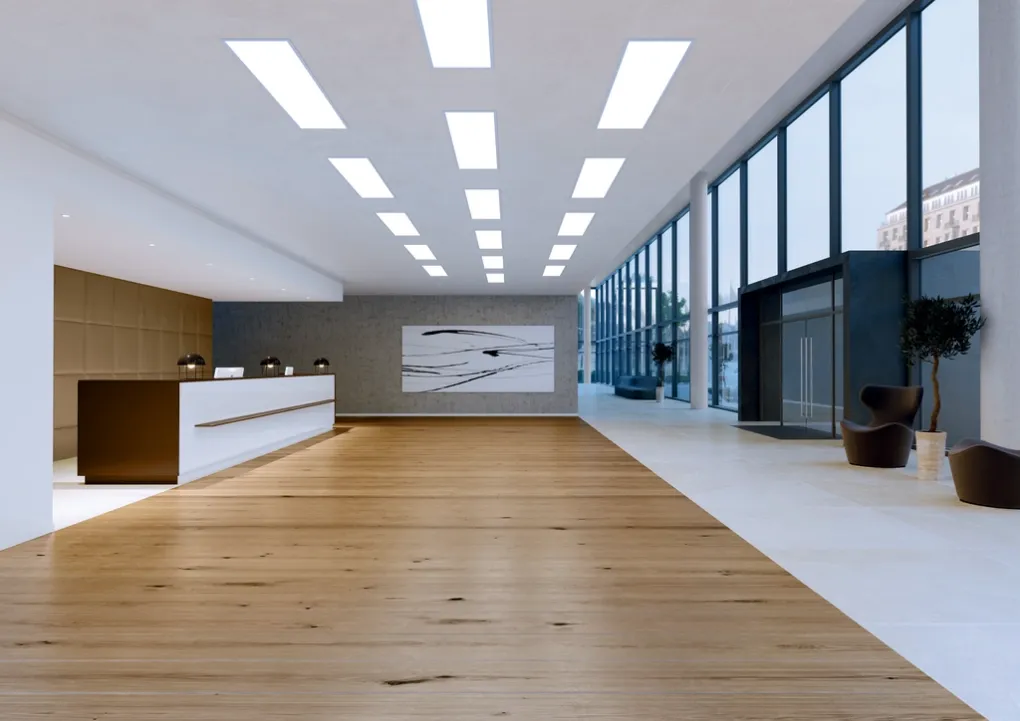
Understanding the difference between Backlit and Edge-lit LED panel lights is essential for lighting contractors, wholesalers, and interior designers. While both provide sleek, modern illumination for offices, schools, and commercial spaces, their internal optics and physical designs are entirely different.
1. Structural Difference (How They Work)
LED Edge-Lit Panel Lights:
- Design: The LEDs are arranged along the inner frame (edges) of the fixture, pointing inward toward a Light Guide Plate (LGP).
- Light Path: Light travels horizontally through the LGP and is redirected downward through a diffuser plate to illuminate the room.
- Profile: Extremely slim (usually around 9mm to 12mm thick).
LED Backlit Panel Lights (Direct-Lit):
- Design: The LEDs are arrayed in a grid evenly across the entire back panel of the fixture, pointing straight down.
- Light Path: Light passes directly through a diffuser plate facing downward, with no Light Guide Plate required.
- Profile: Slightly thicker than edge-lit panels (typically 25mm to 35mm thick).
2. Side-by-Side Comparison
| Feature | LED Edge-Lit Panel Light | LED Backlit (Direct-Lit) Panel Light |
|---|---|---|
| LED Placement | Along the outer frame (edges) | Arrayed in a grid across the back |
| Thickness | Ultra-slim (~9mm–12mm) | Thicker (~25mm–35mm) |
| Light Guide Plate (LGP) | Required (uses acrylic/PMMA) | Not required |
| Risk of Yellowing / LGP Degradation | Higher (LGP can yellow over time under heat) | None (no LGP to degrade) |
| Luminous Efficacy (lm/W) | Moderate (loss of light through edge refraction) | Higher (direct light path maximizes lumens per watt) |
| Manufacturing Cost | Higher (precision engineering for LGP) | More Cost-Effective (simpler optical design) |
3. Advantages of Each Type
Advantages of Backlit Panel Lights (The Contractor's Favorite)
- Higher Energy Efficiency (lm/W): Because the light shines straight down without needing to be redirected from the sides, backlit panels typically deliver better light output per watt.
- Zero Yellowing Risk: Edge-lit panels rely on an acrylic Light Guide Plate. Over years of exposure to heat from the LEDs, cheap LGP materials can turn yellow and cause dark spots or discoloration. Backlit panels completely eliminate this failure point.
- Better Cost-to-Performance Ratio: They are generally cheaper to manufacture, making them a preferred choice for large-scale commercial bids where budget and longevity matter most.
- Even Light Distribution: Direct distribution from the back minimizes the risk of uneven corner brightness.
Advantages of Edge-Lit Panel Lights (The Designer's Choice)
- Ultra-Slim Aesthetics: Their razor-thin profile makes them ideal for shallow ceiling plenums or architectural applications where space is extremely tight.
- Sleek Visual Appeal: When turned off, the face of an edge-lit panel looks completely uniform and minimalist.
- Versatile Mounting: Excellent for specialized pendant mountings or architectural integration where fixture thickness is an aesthetic priority.
Specifier Summary
Choose Backlit Panels for standard grid ceilings (T-bar ceilings) in offices, schools, and hospitals where long-term reliability, high efficacy, and budget-friendly pricing are the primary goals.
Choose Edge-Lit Panels when the project demands an ultra-thin architectural profile.
Technical Specification Comparison: Backlit vs. Edge-Lit LED Panels
| Technical Parameter | LED Backlit Panel Light (Direct-Lit) | LED Edge-Lit Panel Light |
|---|---|---|
| Optical Design | LEDs arrayed uniformly across the rear chassis, shining directly downward through a diffuser. | LEDs positioned along the inner frame, injecting light into an internal Light Guide Plate (LGP). |
| Fixture Thickness | Typically 25mm to 35mm (Requires standard ceiling plenum depth) | Ultra-slim 9mm to 12mm (Ideal for shallow ceilings) |
| Luminous Efficacy | High (typically 130 to 160 lm/W). Direct light path minimizes optical absorption losses. | Moderate (typically 100 to 120 lm/W). Light loss occurs during edge refraction and LGP transmission. |
| Light Guide Plate (LGP) | Not Required. Eliminates optical degradation points. | Required (Acrylic / PMMA). Vulnerable to thermal aging over years of operation. |
| Risk of Yellowing / Dark Spots | Zero. No LGP or edge-injection points to discolor. | Moderate to High. Low-grade LGP materials can yellow under long-term LED thermal load. |
| Light Uniformity & Anti-Glare | Excellent. Even grid distribution prevents corner dimness; easily rated for UGR < 19 with micro-prismatic diffusers. | Good to Moderate. Relies heavily on LGP dot-matrix printing quality to prevent center/edge brightness mismatch. |
| Typical Power Factor (PF) | ≥ 0.95 (High-efficiency flicker-free drivers) | ≥ 0.90 to 0.95 |
| Color Rendering Index (CRI) | Ra ≥ 80 (Optional Ra ≥ 90 available) | Ra ≥ 80 (Optional Ra ≥ 90 available) |
| Ingress Protection (IP) | IP20 standard (IP40/IP54 available on sealed back-boxes) | IP20 standard |
| Mounting Options | Recessed (T-bar grid), Surface-mounted frame, Suspended cables | Recessed, Surface-mounted, Suspended cables |
| Target Application | Primary Commercial Standard: Offices, schools, hospitals, and high-volume government projects where longevity and ROI matter. | Architectural / Space-Constrained: Premium offices, boardrooms, and tight plenums prioritizing ultra-thin aesthetics. |